
1. Importance
Occupational health and safety is a fundamental aspect of the Group’s sustainability approach, as the Group recognises that a safe and healthy working environment is essential to protecting employees, contractors, and other stakeholders across its operations. Due to the nature of the Group’s business, which involves operational and project activities with potential safety risks, effective control of occupational health and safety risks is critical to preventing accidents, injuries, and fatalities. Occupational health and safety is therefore recognized as a key priority that supports regulatory compliance, operational continuity, and responsible business conduct. By emphasizing health and safety, the Group seeks to safeguard its workforce and stakeholders while supporting long‑term sustainable business performance.
2. Targets and Performance
The Group has established clear commitments and performance outcomes to ensure effective occupational health and safety management across all operations, covering employees and contractors.
The Group monitors occupational health and safety performance against targets, including the prevention of accidents, chemical contamination, fire incidents, traffic accidents, lost time injuries, and fatalities. Safety performance is tracked through incident records and key indicators such as the number of accidents, Lost Time Accidents (LTA), and Lost Time Injury Frequency Rate (LTIFR). In 2025, while certain incidents were recorded, none resulted in fatalities.
| Goal | Performance |
|---|---|
| Zero Accident: 0 cases (Maintaining “zero accidents” in 2025) |
The number of accidents = 14 cases |
| Zero Chemical Contamination: 0 cases (Maintaining “zero chemical contamination” in 2025) |
The number of Chemical Contaminations = 0 case |
| Zero Fire: 0 cases (Maintaining “zero fire incidents” in 2025) |
The number of fires = 2 cases |
| Zero Traffic Accident: 0 cases (Maintaining “zero traffic accidents” in 2025) |
The number of traffic accident = 0 case |
| Lost Time Accident (LTA): 0 cases | The number of lost time accidents = 14 cases |
| Lost Time Injury Frequency Rate (LTIFR) – Employees: 0 | No. of injuries per 1,000,000 hours worked = 6.59 |
| Lost Time Injury Frequency Rate (LTIFR) – Contractors: 0 | No. of injuries per 1,000,000 hours worked = 9.41 |
| Fatalities – Employees: 0 | The number of fatalities = 0 |
| Fatalities – Contractors: 0 | The number of fatalities = 0 |
3. Management Approach
The Group conducts its business with a strong commitment to occupational health and safety, recognising that the health and safety of employees, contractors, surrounding communities, and other stakeholders are fundamental to business continuity, operational efficiency, and quality of life. To support this commitment, the Group has established an occupational health and safety management system, together with related policies, manuals, and procedures, which are applied across its operations.
3.1 Integrated Management Framework for Occupational Health and Safety
The Group manages occupational health and safety through an Integrated Management System (IMS) and standardized policies applied across all operations, which are governed under a broader sustainability and risk management framework. Oversight for this system is provided by the Sustainability and Risk Management Committee which comprising members of the Board of Directors, with operational responsibility assigned to management and specialized working teams to ensure that risks are identified, assessed, and controlled.
Occupational Health and Safety Governance Structure
| Role | Responsibility |
|---|---|
| Board of Directors | • Establish a clear, written OHS policy that outlines the organization’s commitment to safety. • Ensure the allocation of sufficient financial, human, and technological resources required to implement and sustain the OHS management system effectively. • Appoint a committee accountable for OHS performance across the Group. |
| Sustainability and Risk Management Committee | • Identify and assess workplace hazards and OHS-related risks in the Group level. • Provides advice on the development of operational frameworks and safety targets for the Group. |
| Executive Committee | • Drives the implementation of concrete safety projects and fosters collaboration across internal and external stakeholders. • Supervises internal controls to ensure systems are robust enough to manage operational health and safety. • Evaluates and screens annual budget allocations, including operational expenses for safety infrastructure. |
| OHS Working Group | • Implements daily measures to prevent accidents and ensure high safety standards in the field. • Promotes personnel development and skill enhancement to improve safety knowledge and potential. • Upholds the requirement for all power plants to meet international OHS management certifications. |
As part of this framework, the Group is committed to providing a safe and healthy working environment for employees, contractors, and other relevant stakeholders across all business activities and continuously improves and enhances a safe and hygienic working environment through regular monitoring, internal audits, corrective actions, and the review of work processes and safety performance. This commitment is put into action by following international standards, specifically ISO 45001, to protect the well-being of employees, contractors, and local communities. To ensure everyone has a voice in this process, the Group has established Safety, Occupational Health, and Environment Committees at operational sites to promote employee participation and oversight in safety management. These committees serve as a channel for communication between management and employees, supporting discussions on workplace safety issues, risk prevention measures, and improvement initiatives. The committees contribute to fostering a safety culture by encouraging shared responsibility, monitoring compliance with safety measures, and supporting corrective actions where necessary.
3.2 Risk Assessment and Control Measures
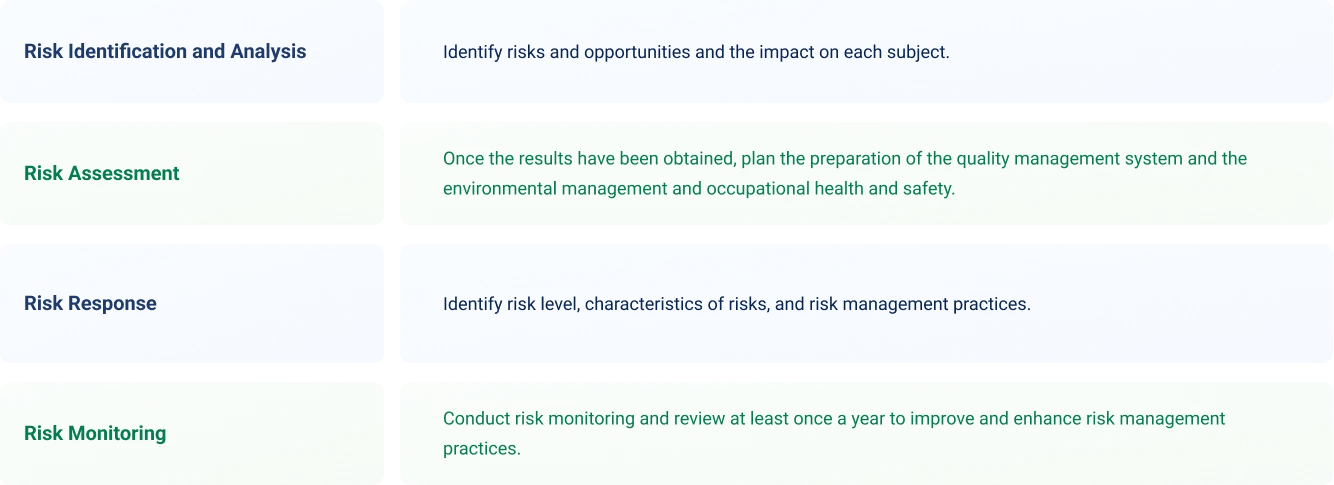
The Group conducts occupational health and safety risk assessments for new projects, construction activities, and existing operations through Environmental Impact Assessments (EIAs) or lender due‑diligence assessment documents prepared to support bank financing, as well as the OHS management system implementation for existing operations. These assessments identify potential hazards associated with machinery, equipment, chemicals, working at height, confined spaces, and other high-risk activities. Control measures are defined prior to work commencement and include safe work procedures, engineering and administrative controls, and the use of appropriate personal protective equipment. Risk assessments are also applied to contractors before entering work areas to ensure readiness and compliance with safety requirements. In addition, the Group promotes employee participation through Safety, Occupational Health, and Environment Committees at operational sites, providing a platform for consultation, communication, and continuous improvement in workplace safety.
3.3 Awareness of Occupational Health and Safety
The Group has implemented role‑specific safety training programs across all business operations, including specialized courses for both employees and contractors. These programs are designed to strengthen awareness and clarify responsibilities related to environmental management, occupational health, and workplace safety. The training also builds safety competencies to ensure that operations at all sites are conducted in accordance with applicable safety standards. In 2025, 19 occupational health and safety training courses were organized with 813 employees and contractors participated. The trainings cover operations across biomass, waste-to-energy, and solar power plants, encompassing both operational and construction phases.
The key courses include the following:
| Curriculum | Number of Training Sessions | Number of Participants (Contractors Included) |
|---|---|---|
| Requirement ISO 9001:2015, ISO 14001:2015, and ISO 45001:2018 | 4 | 82 |
| Internal Audit ISO 9001:2015, ISO 14001:2015, and ISO 45001:2018 | 3 | 73 |
| Code of Practice (CoP) for Environmental Compliance Training | 1 | 9 |
| Basic Safety Training | 15 | 813 |
| Basic Firefighting Training | 15 | 325 |
| First Aid Training | 15 | 325 |
| Fire Evacuation Drill Training | 15 | 325 |
| Safety Awareness and Safety Regulations Refresher Training | 1 | 16 |
| Fire Protection Equipment Usage and Chemical Spill Emergency Drill Training | 1 | 15 |
| Chemical Spill Emergency Response Training | 1 | 10 |
| Safe Chemical Handling and Management Training | 1 | 44 |
| New Employee Orientation: Safety, Environment, Permits, and ESG | 23 | 371 |
| New Employee Orientation: 9S for Sustainable Development | 23 | 371 |
In addition to strengthening safety competencies through training, the Group places importance on protecting employees’ health and well‑being as part of its overall occupational health and safety approach. Since employees are the main force driving the business, the Group also promotes health and safety to prevent work‑related illnesses. Annual occupational health checks are conducted for employees at all levels whose roles involve risks, taking into account factors such as job function, age, gender, and working environment. In addition, annual employee health check‑ups are provided, alongside initiatives that promote overall well‑being and health. The Group also supports employee welfare in accordance with legal requirements, contributing to a safe and healthy working environment.
3.4 Incident Investigation, Recording, and Corrective Actions
The Group has established procedures for the recording, reporting, and investigation of work-related accidents and incidents. All incidents are documented and investigated to identify root causes and contributing factors. Investigation findings are used to define corrective and preventive actions aimed at preventing recurrence. Responsibilities for accident investigation are clearly assigned to supervisors and safety officers to ensure effective implementation. Lessons learned from incidents are communicated within the organization to strengthen safe work practices and continuously improve occupational health and safety performance across operations.
Persons Responsible for the Accident Investigation:
- Supervisors are responsible for supervising the proper work of workers to ensure it is safe, compliant with factory regulations, and suitable for accident investigation to be effective.
- Safety officers are directly involved in preventing accidents and enhancing work safety. They must have knowledge and experience in this field to work effectively.
Key principles of the investigation:
- Investigators must have a clear and concrete common sense.
- Investigators must have knowledge of the production process and be familiar with the machines, workers, and department environments where accidents occur.
- Investigators shoold not be subordinate to the supervisor or a supervisor in the accident department.
- An investigation must be carried out as soon as the accident occurs or as soon as possible to get the facts correctly. Anything that could cause an accident must be investigated thoroughly by a group or working group to identify the actual cause. An investigation is completed when a report is made, and a solution is proposed.
Accident Recording and Reporting:
- Every accident must be recorded and reported.
- The report must contain topics related to event analysis, cause investigation, management's revision, and directive recommendations.
- Reports must be easy to collect or categorized by the nature of the cause or injury or for statistical purposes and other benefits.
4. Projects
Occupational Health and Safety Recognition and Benchmarking
The Group benchmarks its Health and Safety performance against recognized international standard, industry criteria and Thai government standards. Our commitment to maintaining standards above the legal baseline is verified through ISO45001:2018 and consistent external validation from the Ministry of Labour and provincial authorities. During the 2022–2025 period, our practices were confirmed to meet and exceed 'Good Practice' benchmarks through the following recognitions:
- Certificate of Recognition for “Safety Culture Together in the Workplace” from the Ministry of Labour
- Certificate of Recognition as a Model Establishment under the project on enhancing the capacity and role of safety officers in organisational well being
- Award for Meeting the Criteria on Occupational Health and Safety Services in the Workplace from the Provincial Subcommittee on Occupational and Environmental Diseases Control