

1. Importance
Corporate governance is a critical foundation for sustainable business operations, providing the framework through which the Group is directed, controlled, and held accountable. Effective governance is underpinned by a clear separation of oversight and management roles, supporting transparent decision-making and responsible leadership. Strong governance arrangements integrate ethical standards, regulatory compliance, risk management, and robust internal control systems across the organisation. Transparent disclosure, meaningful shareholder participation, and independent assurance further reinforce accountability and trust, enhance organisational resilience, and enable the Group to respond effectively to evolving regulatory, market, and sustainability-related challenges, supporting long-term, sustainable growth.
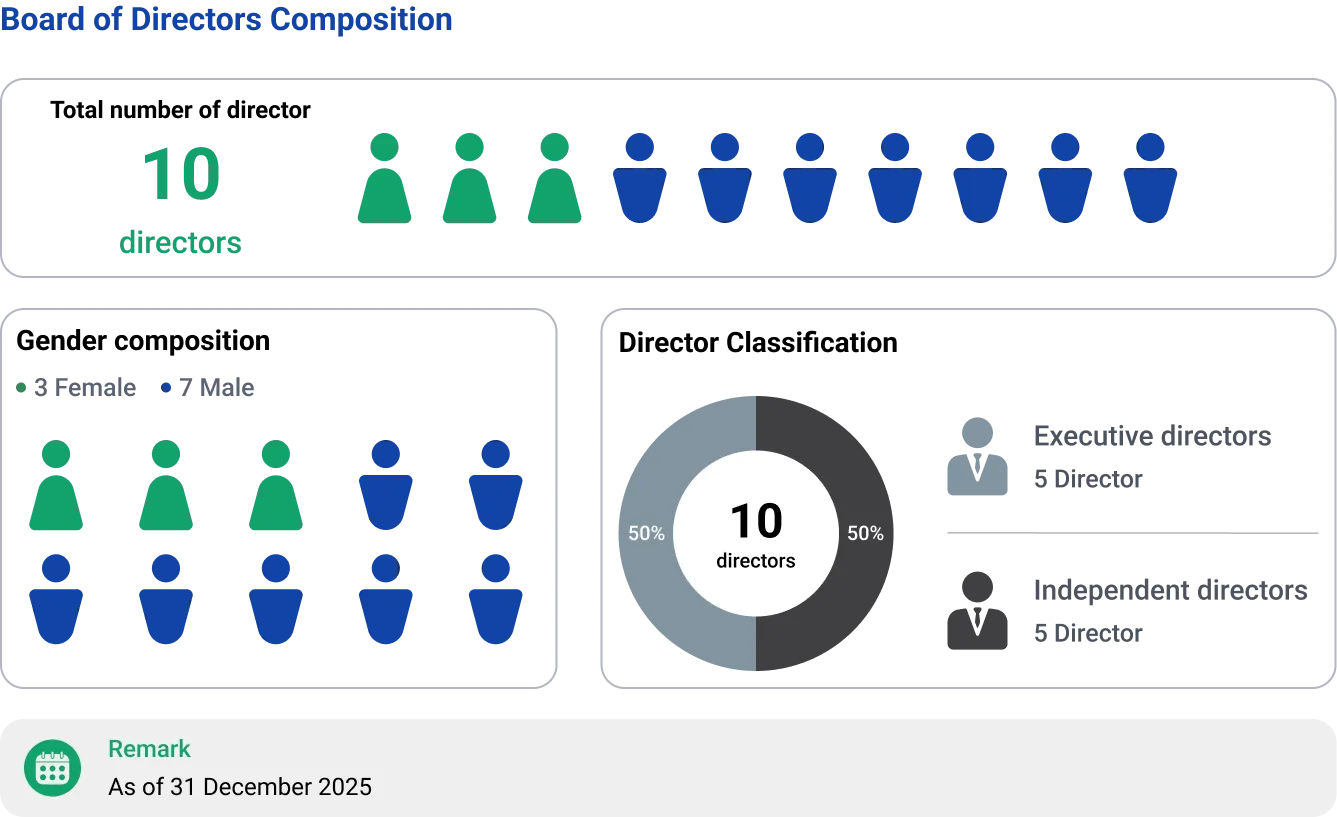
2. Targets and Performance
To demonstrate its commitment to Corporate Governance, ACE has established clear goals and systematically monitors performance against these material topics, as outlined below:
| Goal | 2025 Performance |
|---|---|
| The company places great importance on Board Diversity and has set a target for female directors to comprise at least 30 percent of all company directors by 2030, in order to achieve Gender Diversity on the Board of Directors. | 30 percent (3 female directors out of a total of 10 Board of Directors) |
3. Management Approach
The Group recognises that strong corporate governance is a critical foundation for sustainable business operations, risk management, and long-term value creation. Corporate governance provides the framework through which the Group is directed, overseen, and held accountable, ensuring ethical conduct, transparency, and the effective balance of stakeholder interests.
3.1 Corporate Governance Policy
The Group has established a comprehensive Corporate Governance Policy that outlines the principles, structures, and practices guiding the Board of Directors, management, and employees in conducting business with integrity, transparency, and accountability. The policy is aligned with applicable regulatory requirements and international best practices, and covers key areas including the roles and responsibilities of the Board, protection of shareholder rights, equitable treatment of stakeholders, disclosure and transparency, and internal control mechanisms.
The policy serves as a foundational framework to ensure effective oversight, ethical business conduct, and long-term sustainable value creation. It is subject to periodic review to reflect evolving regulatory expectations, business environments, and governance standards.
3.2 Governance Structure and Oversight
The Group is governed by a Board of Directors as the highest governing body, responsible for setting strategic direction, approving policies, and overseeing management performance. The Board is supported by specialised committees, including the Audit Committee, Nomination and Remuneration Committee, Sustainability and Risk Management Committee, and Executive Committee, each operating under clearly defined charters. Board compositions, committee structures, and performance evaluations are reviewed annually to ensure effectiveness, independence, and alignment with good corporate governance principles.
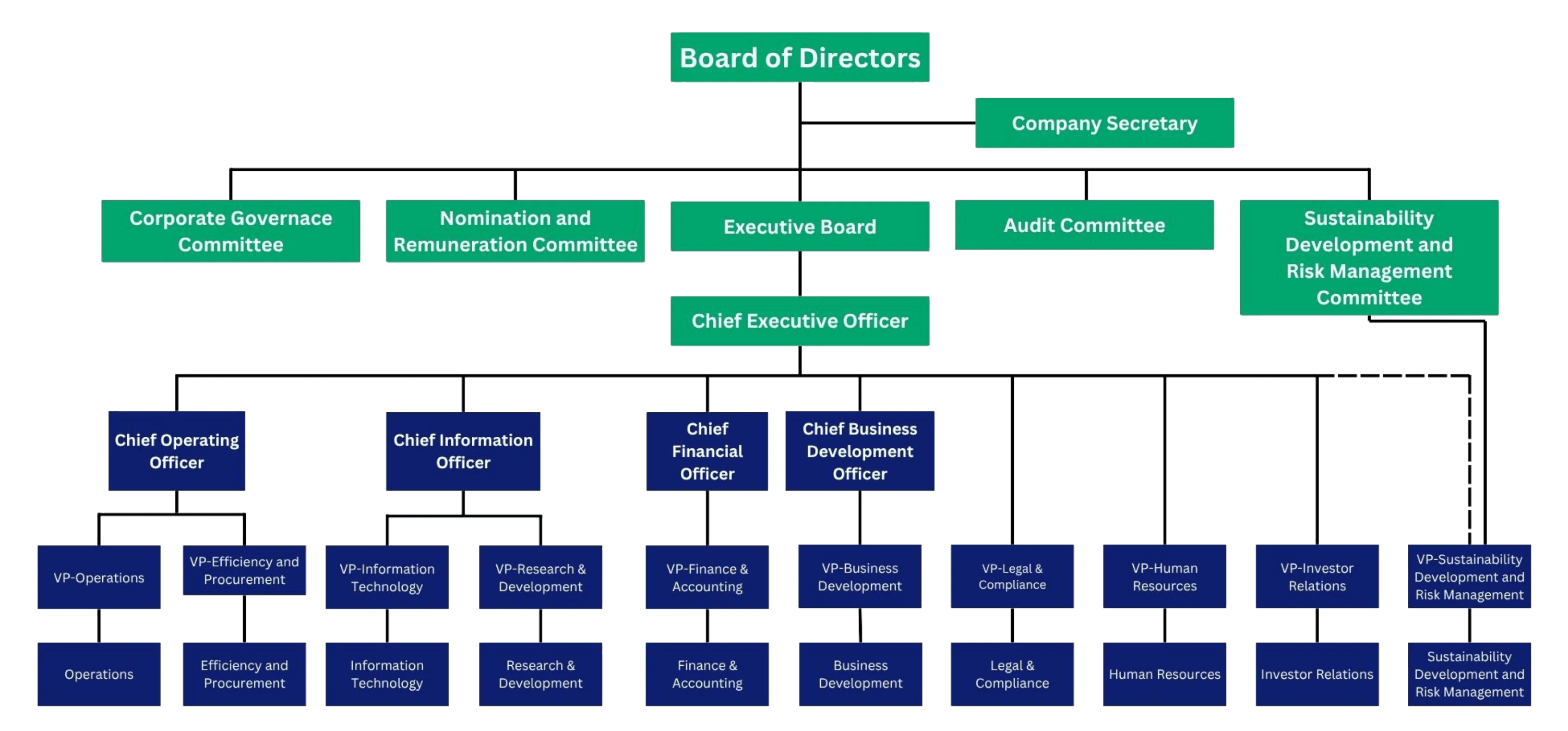
Board Sub-Committees Composition
| Number of Directors | Gender | ||||
|---|---|---|---|---|---|
| Total Committee Members | Executive Directors | Independent Directors | Female | Male | |
| Corporate Governance Committee* |
- | - | - | - | - |
| Nomination and Remuneration Committee |
3 | 1 | 2 | 2 | 1 |
| Executive Committee |
6 | 6 | 0 | 1 | 5 |
| Audit Committee | 3 | 0 | 3 | 2 | 1 |
| Sustainability Development and Risk Management Committee |
5 | 5 | 0 | 1 | 4 |
Remark: As of 31 December 2025
*As of 2025, the Corporate Governance Committee has not yet been formally appointed. However, a resolution to approve remuneration for this committee has already been passed.
The management team, led by the Chief Executive Officer, is responsible for implementing the Group’s strategies and managing day-to-day operations in line with the policies and direction approved by the Board of Directors. Management is accountable for operational performance, risk management, internal controls, and the integration of sustainability considerations into business operations, and works closely with the Board and relevant committees through regular reporting and performance reviews to support effective governance and long-term value creation.
The Group maintains a clear separation between the roles of Chairperson and Chief Executive Officer, with the Chairman of the Board of Directors serving as an independent director.
3.3 Roles and Responsibilities of the Board of Directors
The Board of Directors is accountable to shareholders for the operations of the Group and its subsidiaries. The Board sets policies and strategic direction and oversees management to ensure that operations are conducted in line with long-term objectives, applicable laws, business ethics, and the sustainable creation of shareholder value, while considering the interests of all stakeholders. The roles and responsibilities of the Board are defined in the Board of Directors’ Charter.
For further information, please refer to the Charter of the Board of Directors.
The Board establishes and annually reviews the Corporate Governance Policy and Corporate Governance Manual to guide directors, management, and employees. The Group applies a Code of Conduct to ensure ethical business practices toward shareholders, customers, business partners, employees, society, and the environment.
The Board oversees the management of conflicts of interest and related-party transactions in accordance with laws and regulations, ensures the effectiveness of internal control systems through independent internal audit reviews, and implements an enterprise-wide risk management framework to identify and manage key risks affecting the Group and its subsidiaries.
For further information, please refer to the Conflict of Interest Prevention Policy.
Additionally, the roles and responsibilities of each sub-board committee are outlined in the Board Charters for the respective committees.
3.4 Board and Committee Meeting
The Group discloses detailed attendance records for all individual directors at meetings of the Board of Directors and each Board committee in the Annual Report. The disclosure includes the number of meetings held during the year by the Board and each committee, together with the attendance of each director at those meetings, demonstrating a high level of participation, accountability, and effective governance oversight throughout the reporting period.
| Name | Position | Board of Director | Audit Committee | Nomination and Remuneration |
Sustainability and Risk Management |
Executive Committee | Annual General Meeting of Shareholder |
|---|---|---|---|---|---|---|---|
| Total 10 Times |
Total 11 Times |
Total 3 Times |
Total 2 Times |
Total 10 Times |
Total 1 Time |
||
| Mr. Monton Sudprasert | Chairman of the Board of Directors | 10/10 | 1/1 | ||||
| Mr. Charoon Intachan | Independent Director | 9/10 | 1/1 | ||||
| Ms. Chonticha Chitraporn | Independent Director | 10/10 | 11/11 | 1/1 | |||
| Mr. Nuekrak Baingern | Independent Director | 10/10 | 11/11 | 3/3 | 1/1 | ||
| Mrs. Patchanee Sutheevitan | Independent Director | 10/10 | 11/11 | 3/3 | 1/1 | ||
| Ms. Jiratha Dumnernchanvanit | Director | 10/10 | 3/3 | 2/2 | 10/10 | 1/1 | |
| Mr. Teerawut Dumnernchanvanit | Director | 10/10 | 10/10 | 1/1 | |||
| Mr. Pornmett Dumnernchanvanit | Director | 10/10 | 2/2 | 10/10 | 1/1 | ||
| Mr. Tanavijit Ankapipatchai | Director | 10/10 | 2/2 | 10/10 | 1/1 | ||
| Mr. Tanachai Bunditvorapoom | Director | 10/10 | 2/2 | 10/10 | 1/1 | ||
| Average Board Meeting Attendance Rate (%) |
99 | 100 | 100 | 100 | 100 | 100 | |
For further information, please refer to the Annual Report 2025 (PDF page 313).
3.5 Evaluation of Board Effectiveness
The Board of Directors periodically reviews its effectiveness through ongoing deliberations at Board and Board committee meetings, focusing on board structure, composition, roles and responsibilities, and the effectiveness of governance and oversight processes in supporting the Group’s strategic direction and sustainable growth.
The Board also conducts a formal annual evaluation of board effectiveness, covering the performance of the Board as a whole and all Board committees, including meeting effectiveness, strategic and risk oversight, internal control, and compliance with corporate governance principles.
In this process, the Audit Committee supports the Board’s evaluation by conducting an annual self-assessment of its performance in accordance with its Charter and reporting the results to the Board, thereby contributing to continuous improvement of overall governance effectiveness. For further information, please refer to the Charter of the Audit Committee.
3.6 Directors and Executive’s Remuneration
Board-level Remuneration
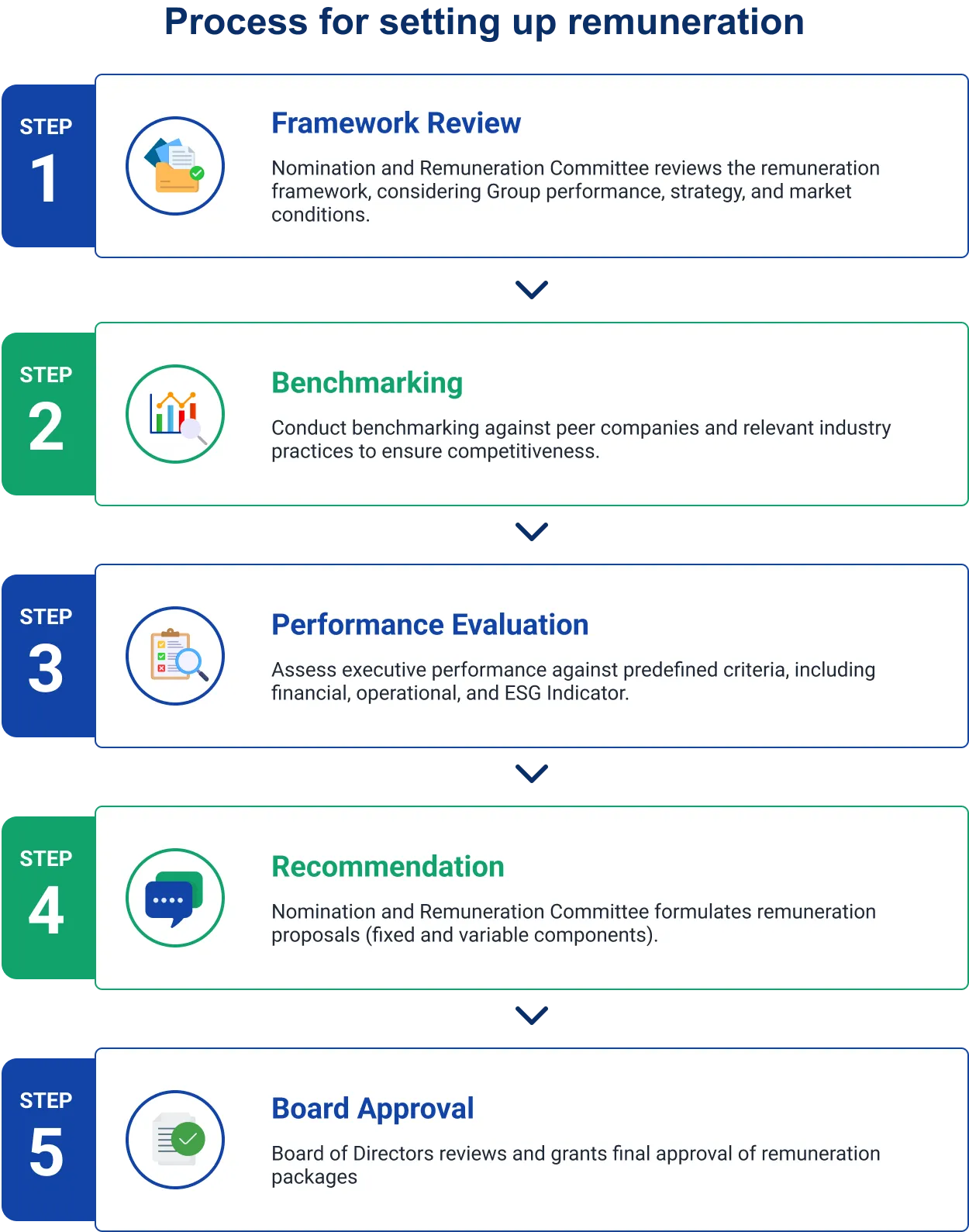
The Group has established a structured remuneration framework overseen by the Nomination and Remuneration Committee, which formulates remuneration policies and criteria for the Board of Directors and Board sub-committees for approval by the Board of Directors and, where applicable, the Shareholders’ Meeting.
Board remuneration is determined annually in monetary and non-monetary forms, taking into account duties, responsibilities, legal obligations, performance, and value creation, as well as benchmarking against companies of similar size within the same industry to ensure appropriateness and alignment with long-term shareholder value creation.
| Board of Directors | Meeting Allowance (THB/time) |
Monthly Salary (THB/month) |
|---|---|---|
Board of Directors
|
35,000
30,000
|
30,000
25,000
|
Corporate Governance Committee
|
30,000
25,000
|
-
-
|
Nomination and Remuneration Committee
|
30,000
25,000
|
-
-
|
Executive Board
|
30,000
25,000
|
-
-
|
Audit Committee
|
30,000
25,000
|
-
-
|
Sustainability and Risk Management Committee
|
30,000
25,000
|
-
-
|
Remark:
- The Group’s Annual General Shareholder Meeting on 30 April 2025 approved the remuneration of the Board of Directors and Sub-Committees for 2025.
- The Nomination and Remuneration Committee comprises a mix of 2 independent directors (non-executive) and an executive director, while the Audit Committee consists entirely of independent (non-executive) directors.
Executive-level Remuneration
Remuneration for senior executives and top management, including the Chief Executive Officer, is determined under the Group’s structured governance framework overseen by the Nomination and Remuneration Committee and approved by the Board of Directors. The remuneration framework is designed to support the execution of the Group’s strategy, operational performance, and long-term value creation.
Executive remuneration comprises fixed and variable components. Fixed remuneration includes salary and benefits, while variable remuneration consists of performance-based annual bonuses, together with provident fund contributions and other benefits.
Executive remuneration includes performance-linked incentive mechanisms intended to align remuneration outcomes with both short-term operational performance and the Group’s long-term strategic objectives. Performance evaluation criteria consider organisational performance and support sustainable value creation, with recognition of environmental, social, and governance (ESG) factors.
For the fiscal year ended 31 December 2025, total remuneration expenses for executives are as follows:
| Type of Renumeration | Total Expenses for Executives (Baht) |
|---|---|
| Number of Executives (Person) | 4 |
| Salary, Bonus, Provident Fund, and Other Benefits (Baht) | 28,597,274 |
Remark: Remuneration for the executives did not include the VP-Finance & Accounting and the Accounting Manager.
3.7 Shareholder Rights
The Group provides for a one-share, one-vote principle for all resolutions at general meetings, with all outstanding shares carrying equal voting rights. Shareholders are accorded equitable rights, including voting, participation in general meetings, dividend entitlements, access to accurate information, and the ability to propose agenda items or nominate directors in accordance with regulatory requirements. The Group consistently demonstrates high standards in shareholder meeting quality and disclosure.
4. Relevant Documents